The Organic CSA Vegetable Field

The Organic CSA Vegetable Field
A picture of Plant City's (eastern Hillsborough County) first organic CSA farm
Showing posts with label fertilizer. Show all posts

Friday, December 2, 2016

Week 4, 2016-2017 Season

I have been doing a lot of planting in the last two weeks.  I have planted in the field, strawberries, onions, mustard greens, kale, kohlrabi, lettuce, broccoli, and beets.  I still have scallions, cabbage, and cauliflower to go.  I have also sown seeds for more lettuce, kale, and Swiss chard in trays.
I have also finally got my fertilizer injector working after ordering a few parts.  Now I can inject liquid organic fertilizer directly through the drip tape to help out on the fertility of the crops.  I am hoping that it will give us a little more ability to adjust the nitrogen level of the plants.  There is some fine tuning of the rate and concentration of the the mix before we are off and running.  The fertilizer is very viscous so it needs to be diluted but I also don't want to let the water run for too long and leach all the pre-plant fertilizer that is there; so I am still working out the details.
Everything else is humming along fine with bountiful squashes and greens sizing up nicely.  This, so far, is the best crop growth we have had since we started growing organic veggies.  Soon the tomatoes will find their fertilizer and should be off to the races along with the cucumbers.  I'm still waiting for that salad with tomatoes, cucumbers, and lettuce ready at the same time.

Monday, November 7, 2016

First Harvest Nears for 2016-2017 Season

Our first harvest is almost upon us.  For two years I have tried to start the farm harvest of fresh veggies to our members before Thanksgiving so that our produce could be included on the menu of the festivities.  Unfortunately, we have had problems with seed starting soil and have lost our seedlings two years in a row form different causes.  We almost had that happen again this year but I was able to catch it in time so things weren't pushed back too far.  It appears that saving the bale of leftover soil over the summer causes pH changes that are not conducive to plant growth.  I made a quick change and bought fresh soil and things grew the way they were supposed to.

Two hurricanes didn't help things out either.  Besides rotting a few seedling trays down and killing most of our pepper plants when the plastic mulch blew off, we escaped major damage.  The eggplants were injured but appeared to have recovered.

I have adjusted our nutritional program this year and the plants have responded remarkably.  I have never grown such a beautiful crop of vegetables as I see in the field right now.  Everything looks amazing! TBTG! Our squash plants (zucchini, yellow squash, and patty pan) are ten days earlier than expected and we have been picking bushels of cucurbits already.  Turnips, diakon, broccoli raab, and green bean plants are also looking tremendous and should be close for the picking this Saturday (Nov. 12) a full two weeks ahead of schedule!  Goal #1 accomplished!

I have a few other harvest goals I would like to meet this year.  Goal #2 - Have lettuce, tomato, cucumber, and scallions ready at the same time for a delicious salad.  We usually have all of this ready throughout the season but we never have it all at once.  Goal #3 - Have carrots, cabbage, and potatoes ready for St. Patrick's Day.  A good Irish Catholic tradition for our family has been to have a pot of corned beef and cabbage for St. Paddy's Day.  Whether or not this is truly "traditional" is up for debate, but it is traditional in our family, and now has passed into the second generation.  I would like to supply our pot with Steed Farm's, fresh produce, for the feast day. St Patrick pray for us!

So the harvest forecast for this Saturday (Nov. 12) is lots of squash, turnip greens, diakon radish, broccoli raab, sweet potatoes, mint, and Thai basil.  Green beans are really close but may show up on next week's menu.  We will also have as a bonus avocados from the tree at the house and starfruit from the tree at the office. This should make for a nice basket of produce to plan some meals for next week.

Just to round out the news from the farm, the tomato transplants are planted in the house along with the cucumber seeds.  The carrots have been sown this last week along with a fresh crop of broccoli raab and cilantro.   We should be transplanting to the field, bok choi, kale, collards, cabbage, lettuce, mustard greens, broccoli, and kohlrabi.  The strawberry plants are almost rooted and will be transplanted shortly as well.  Lots of work ahead.

Saturday, January 12, 2013

Week 8, 2013

Things are looking pretty good thus far. We are steadily moving along in the season. The broccoli is the best we have ever grown and the collards and the new kohlrabi look fantastic. Our komatsuna has dropped off with the higher temperatures and the turnips and the diakons are in suspended animation. The root aphids are back again and sucking the life out of them. I am trying a few organic pesticides to remedy the problem but not having any luck so far. Ladybugs and predators are now widely dispersed around the crops and are doing their jobs keeping anymore aphids at bay.

I had to make an unusual night harvest last week which was the first of its kind at Steed Farms.  I went out with my head lamp on in the pitch black after all the kids got off to bed.  It was actually pretty nice to harvest at night.  Its a whole different world at the farm at night.  It was nice not to be rushed to harvest and wash everything before noon.  I am very thankful that my brother Pat was able to cover for me in the morning and wash everything while I could assist with a retreat at our church.  It was nice to see the stars and moon while I worked.  It was a little creepy when the coyotes started to howl not too far off.  I also found out that I have a family of rats where I keep my pots.  I could hear them moving about.  My white light died out but still had the use of my red LED light on my head lamp.  I shined it over there when I heard them and I could see their little beady, red eyes watching me.

We lost a spinach planting, and a carrot crop to bad germination or possibly fertilizer problems. I lost about 25% of our tomatoes and our entire pepper crop from transplants in the greenhouse. I thought that maybe I had done something wrong until a fellow grower spoke with me about all the problems he had with losing crops with the same fertilizer I was using. I did notice huge amounts of fly larvae in the fertilizer in the pots and just assumed that those flies came in after planting. My friend mentioned he had the exact same thing under plastic mulch out in the field which would be next to impossible to get flies that fast under the plastic. He is pursuing the company for the problems and we will see what happens.

We tried a few more strawberry plants again this year for our own trial. I planted them in pots with non-organic slow release fertilizer. They are doing much better this year. It seemed that the organic fertilizer never would release enough nutrients to produce much fruit. This year we have already harvested a half pint off of about 20 plants. The taste was out of this world.

We have planted leeks, lettuce, radish, onions red and sweet out in the field. I will start dusting off the seed packets for the spring here shortly. In no time at all we will be sowing squash, tomatoes, peppers, zucchini, peas and beans again.

We are eagerly awaiting potatoes for planting. They should be arriving in the next few days and will get planted immediately. I ordered red La Soda which worked pretty good two years ago. Last year the freezes got them and we got very little yield.

I have pictures but can't seem to get Blogger to accept them.  Maybe next post...

Wednesday, October 27, 2010

Farm Happenings

We have just planted our squash, zucchini, napa cabbage, and red bok choy out to the fields. We also planted 10 different varieties of lettuce in 72 cell trays. I had to spray some organic pesticides for aphids and whiteflies. We are also starting to develop some downy mildew on the cucumbers. The cucumbers are coming in early this year; we have already picked about a dozen. I hope they hold up for harvest time in November. Our green beans are looking very yellow and our eggplant seems to be in a holding pattern. This is what happens when you change fertilizers. It is best if you can see how it works on different items and different conditions. We were not able to get our usual Sustane fertilizer and had to go with something else. It is not reacting the same way. We also have not had any rain lately so the fertilizer that is releasing is not making it to the roots. This might explain our yellow beans and slow eggplant.

My youngest brother Patrick has joined us for a few weeks out at the farm. He needed a place to crash and was willing to work in the fields. He has been a big help so far, cleaning up the nursery and planting many of the vegetables in the trays and field.

It's nice to see the oranges starting to turn orange again. They almost go unnoticed during most of the season disguised in a camouflage green. One really needs to look for them on the tree. And then almost magically they start turning the first shades of yellow, and then reappear into view. This is where I start thinking about how good they taste in the wintertime, and about how nice it is to cut one off the tree and eat it while I'm working.

We had a loss of one of the young chicks this last week. Something, maybe a raccoon reached under the hen house and took a bite of one and killed it. We made some adjustments to the pen and hopefully it will not happen again. Nathan and I got it out of the pen and buried it beneath one of the orange trees

Tuesday, January 26, 2010

Second Eight Weeks Season Starts

We are about to start again on the next eight week harvest schedule. We needed one week to let plants resume growth after the freezes. It looks like things have started to green up again and are finally doing some growth. I have just planted some bean, peas, and sweet corn. I know it is a bit early but I am trying to out grow some of the pests that we usually see. I have been filling some trays for the tomatoes, cantaloupe (which I am going to try again), peppers, zukes, and other squash. I think that we are going to risk the cold and beat the viruses. At least that is the strategy for this season. We will see what happens.

I just put in my seed orders for the warmer weather vegetables from Johnny's Seeds, Southern Seed Exposure, and High Mowing Seeds ( a new company we are trying for the first time). I love to look through the catalogs. It is always easier to grow the vegetables in my mind than in the field. I am trying earlier ripening varieties and plant them quicker in the colder weather and see what happens. Especially the tomatoes and corn. We did corn fine last year, but struggled miserably with tomato and harvested a few green tomatoes. There was no way to let them ripen to red; too many stink bugs poking holes in them. I am trying to see if we can be harvesting when the stinkbugs get up and running. Let's see who wins this race!

I topdressed all the vegetables with Rhizogen fertilizer 3-2-2. It doesn't work as well as the Sustain which I really liked but our distributor is no longer stocking Sustain. So we will adapt, unless I can find a Sustain supplier nearby.

The potatoes are cracking the ground now and this is also another experiment we are trying to evaluate. These are planted about 6 weeks earlier than I normally would plant but I think that they can handle it. Lots of learning to be had!

Monday, November 24, 2008

Fall Season Underway

The strawberries around the county are growing, the citrus is turning sweeter by the day, and the vegetables are being harvested. I enjoy this time of the year. Holidays, baseball finals, (Go Rays!), college football (Go Gators), pro football (Go Bucs), and eating events.


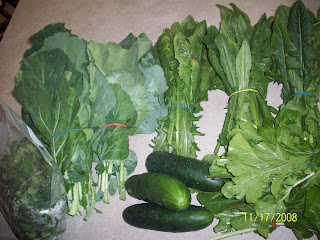
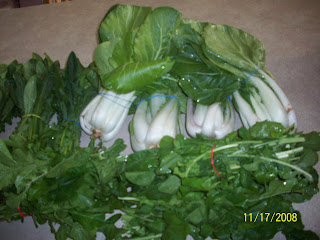
Two pictures of our harvested crops!

We are still planting lettuces, cilantro, carrots, and onions. I started the red onion (Mars) in a tray and will be transplanting them out. I used organic soil and when they started to germinate out of the soil I top-dressed with an organic fertilizer (Sustane). I didn't have much luck with the horse poop this year. There was way too much wood shavings and it is having a very bad effect on the the germination of the seeds. I guess that they are drying out too fast. We are harvesting bok choy, oregano, mint, mustard, and collards. New this week to harvest are the citrus (Hamlins), dandelion, and parsley. The cucumbers are finished. I top dressed the entire field with an organic fertilizer (Bradfield) and weeded half of the plot. I will weed the next half this week and plant a few more things. The pest pressure is pretty light and there are ladybugs all over the place.

Tuesday, April 15, 2008

Looking Good!

Virus infected squash.

The summer trial.


Good news! We sold our first value added organic products this week. I was able to sell some of our transplants to the local hardware store and they have already been moving out of the store. We sold 6 trays of 6 six packs vegetables tomatoes and peppers, and 2 trays of 24 cup peat pots. The proprietor Ronald Stevens of Stevens Hardware liked the plants and would like to buy more in the future. I don't think that he cares that the plants are totally organic but it makes me feel really good that they are and people are buying them. I believe next year we will charge a premium for the organic nature of the product and market the plants a little better. The trials for our summer crops are doing well except for the squash which got viruses almost immediately from whiteflies. I bought a screen but then forgot that the flowers were going to need to be fertilized by insects. We have a lot of bees and other natural pollinators around. The French melons are starting to get downey mildew but the cantaloupe, galia melons, cucumbers and tomatoes are doing great. I have already picked about 4 nice cucumbers off the vines, and a few yellow squash and one zucchini before they got viruses. I planted our sweet corn, two kinds of peppers and eggplants. I fertilized with Sustane fertilizer to follow the recommendations and I have sprayed copper for fungi and Entrust (which is an organic spinosad insecticide) for bugs on almost all of the plants. We will see how things progress. I hope to have some pictures of things this week. We lost our camera and are trying to replace it.

Friday, April 4, 2008

Test Results In...A+!

I can hardly believe it. We got our results from the soil test in and it was incredibly good. We have increased our organic matter of the soil from about 2% to 7.1% in a single season! Organic matter in the soil is the water, nutrient, and microbial sponge that releases and protects the crop plants. Having a fertile soil is the mainstay of an organic crop. Our cover crop winter rygrass and our horse manure has greatly increased the fertility of our trial plot. We have the equivalent of 186 lbs of Nitrogen, 736 lbs of P2O5 (phosphorous oxide), and 439 lbs of K2O (Potash) per acre. Those numbers are very high. In fact much higher than needed to grow a decent crop. Our nitrate nitrogen was only 7 parts per million which means that the soluble form of nitrogen that plants use is very low. All our nitrogen is tied up in organic matter that has not released yet. Amazingly the recommendations from the agricultural lab was to add 100lbs of Nitrogen per acre and 20 lbs of potash to release those nutrients to the plants quicker. I called and asked why they would want even more fertilizer on the field and they said that it would depend on how the weather went if that fertility in the soil would release to the plants. I think that I will supplement some of trials and not other to see if there is indeed a difference. The crops are growing very well and looking very nice so far. We have little baby squash, cucumbers, and melons forming on the plants.

Thursday, March 27, 2008

Planting Underway

Cucumber plants newly planted with some straggling cover crop still surviving


Transplants growing for the field and possible sale.

The weather is bouncing around as usual. Heavy rains, upper 30 F., lower 80's F. all within another week. Despite the climate, I have planted tomatoes, and bell pepper this week in our trial gardens. Everything seems to be doing well even when our fish fertilizer was applied wrong. The person that was helping me fertilize mixed about 32 times the recommended rate. When I realized what happened about 4 hours later, I tried to drench everything out with a leaching water. I got some leaf burn a few days later on the tomato transplants and some melons. But I think that they will recover. The plants that were planted last week are growing well. Our peaches, blueberries, and blackberries are maturing well. I am seeing very little pests around this year. It might be because I am seeing a bunch more ladybugs on the plants and weeds. We are still harvesting beets, lettuce, and carrots. I hope to plant jalapeno peppers this week. I am taking a soil sample to have it tested so we can see how fertile the soil is after the horse manure and rye grass was incorporated. Then I will adjust my fertilizer levels accordingly. I hope next week to be able to summarize the results of our test plots by variety and let you all know how the varieties we tried fared in this climate.

Friday, March 21, 2008

Welcome, Spring!

It is officially one day after Spring. At Steed Farms I am always happy to see the sun moving higher in the sky and the earth warming up. The draw back to warmer temperatures is the need to water more. I planted yellow crooked neck squash, zuchinni, three kinds of beans (two bush, and one Italian flat pole bean), a tropical pumpkin that I ate for the first time in the winter and saved the seeds from, and a cucmber that I have selected for its production in our garden plot. Everything is coming along fine. The squash seemed to be having a little shock from the transplant. I found a distributor for organic fertilizer both dry and fish emulsion the company is JR Johnson. I purchased a Dramatic K fish hydroysate 2-5-0.2 and a dry 8-2-4 called Sustane. We will start trying them out.

Tuesday, March 4, 2008

Fertilizer blues

Dead tomato plants from a frost.


I have been having trouble with the fertility on the vegetables in the trial gardens. I haven't quite worked out how much to apply. Growing organically is so different from conventional growing in terms of fertility. I am having trouble adjusting to it. Conventionally you just apply some fertilizer over the top or in a band next to the plants and they respond. I have been apply organic fertilizers and it take a while for the plants to pick up the nutrients. It seems so much slower. I can tell that the plants are nutrient starved in the trial garden, but the amounts that I put on don't seem to do much. The amounts that I apply with an organic 6-2-4 would fry conventionally grown plants with the same amounts of synthetic fertilizer. I was getting concerned about my transplants not growing fast enough so I applied more fertilizer over the top. I happened to do this the day before the frost came. I have lost a bunch of my tomato plants. I thought that it was the fertilizer but I checked with my EC meter and the levels look fine. An EC meter is a great tool to check your fertility level. It stands for electrical conductivity meter. It measures the amount of soluble salts present in solution. There are different ways to measure it. I use a one part growing media to two parts water, stir it up, and let it sit for about 5 minutes, strain the water off, and put it in the meter and measure the results. Results of 0-0.5 are too low. 0.5-1.5 is acceptable, and 1.5 or greater is high in fertility. If it is too high it may burn your plants. Meters are fairly cheap and a great way to keep things in the right range. My transplants were 1.0 which is within a good range. So I guess the frost did more damage than I thought. It measured 39 F. but there was frost on the plants. I guess I need to get over the cringing feeling when I apply organic fertilizers. I always feel that I am going to burn the plants. I am learning that the soluble salt levels are lower in organic fertilizers and I can apply a larger amount without problems.

Tuesday, January 15, 2008

Off To The Market


I pulled out of our farm at 6:oo on Saturday accompanied by the sounds of bluegrass emanating from our local independent radio station WNMF 88.5 "Always at the extreme left on the radio" as one of their DJs likes to say. You can take this both literally and figuratively. It seemed somewhat fitting to go off to the market with an older type of folk music playing. I know that it is commonplace for some to go with their wares to the local market, but it felt refreshingly new and I felt somewhat nostalgic for a bygone era as I headed down the road in pitch blackness. The weather was great all day about 70 F and a little overcast so it was not too hot. I only had curly mustard greens, which were cut the night before, washed, bundled, and put on ice in a cooler. The other item was Hamlin oranges, which were also washed, and placed in an old wash tub. They looked awesome. Our oranges look great this time of year with a little chill to change the color and raise the sugar levels. They really sparkle with a little wash. To fill in the booth space I brought a truckload of plants from the nursery side of our operation. Everyone liked our booth display and I passed out all of the business cards I had from the interest in our plants. I sold all the oranges and eventually sold out the remaining mustard to The Corner Store, which is our first customer for our produce. I had numerous people tell me that our produce prices were too low. One woman who was snowbirding from New England stood there in disbelief and kept repeating the phrase, "Twelve oranges for $1.00?" I kept saying that was correct. She bought a dozen. I even had the other organic grower come over and tell me that my prices on the greens were too low. She was selling her bunches for $2.00 and mine were $1.25. She sold out and I had the majority of mine left before The Corner Store bought me out. Go figure! Jenn told me she thought our prices were too low. I am going to let her set the prices from now on. I also realized that people really couldn't buy landscape plants at the market. People can’t walk around with a seven-gallon shrub that they impulse bought to place in their landscape. I need to work on our product mix! Maybe some vegetable or annual transplants for the spring might work better, or some small "Wow" plants.
I did learn a lesson about value added products. The Corner Store was juicing our oranges and putting them in a cup and selling it for about four times the amount I sold them for. Another gentleman was selling organic jams and jellies he made the night before. He set up in about 20 minutes, had one table, had about as much value in the space as I did, and he almost sold out. He was selling his jars for $5.00. I was selling plants that took me three to four months to grow for $2.00. I had to deal with all the weather, the water, insects, and diseases. I will start thinking hard about value added products. We did cut up the oranges for people to try them. That was Jenn’s idea. It certainly helped us make some sales. Some people would start walking away from our booth with an orange slice and then come back and purchase some. If you have any other ideas for marketing or value-added products for the market you are welcome to share it with us and others on this blog.

My father bought us an action-hoe or loop hoe the kind that looks like a stirrup. I used it to weed in the trial garden. I love it. Thanks Dad! You didn’t have to do that, but I really appreciated it.

I added a little fertilizer to the beds to help them grow out of the freeze damage. Half of our tomatoes died in the transplant flat. I think that it was too high a salt content in my liquid fertilizer. I checked the salt level with a meter I have and it was off the charts. This week I diluted it down by 5 parts water. I kept thinking that the seedling lettuce looked much better than expected with a one time feed with a liquid fertilizer. They were probably right on the border of death with extreme fertilizer. Note to self: Always check the salt level of new batches of liquid nutrients. This was a very valuable week in terms of the volume of knowledge we have gained!

Wednesday, January 2, 2008

Happy New Year!

This week we weeded the entire trial garden. My Dad and I had some good conversation about how they weeded in the "Old Country" (Ireland) while we toiled. They used to plant turnips and cabbage in rows. He would work down the rows weeding and thinning plants. Sounds like things don't change that much in terms of weeding. I did however try his new hoe. It looks like a stirrup and is called double edge hoe or a loop hoe. It was very effective and reduce amount of time to hoe dramatically over the traditional hoe. I will be purchasing one shortly. It passes through the earth cutting the weeds at the roots and doesn't pull the earth as well as the weeds like the traditional hoe.

I made a batch of liquid fertilizer/compost. I was wanting some liquid fertilizer to start off our seedlings that I will be transplanting later on. I figured that this would give the crop plants a big head start with the weeds and help them out-compete their adversaries. The fertilizer is made from old compost, organic fertilizer, a splash of Companion fungicide which is a beneficial fungus that competes with other fungi, and water. I let it sit for a few days while stirring to add oxygen whenever I pass the bucket. I would like to add oxygen to the container without using any electric. I think a small windmill that could stir and add oxygen would be just the ticket. The seedlings are for the trial garden to find better varieties than what I currently have. I planted Eros escarole, Marimba red leaf lettuce and starting a trial of New Girl tomato.

We harvested collard greens for New Years Day. Eating collards and black-eye peas is a Southern tradition for New Years day. The greens signify money and the peas represent luck for the coming new year. I have heard of hiding a penny in with the peas and whoever finds the coin gets the luck. We prefer not to risk the unfortunate rendezvous of currency with an unsuspecting throat, and we all share the good luck by eating the peas. It's a little safer that way. Jenn's mother puts a little olive oil, sugar, and salt in a pot with the collards and boils them. The sugar takes away the bitter taste of the collards and they are delicious. Best of luck to you and yours this new year.